




What you will find in this digital report:
- 4 key forces shaping the future of work
- 16 trends tranforming how we work
- insights into workforce implecations and what's next
Hybrid Super Teams
Role Redesign

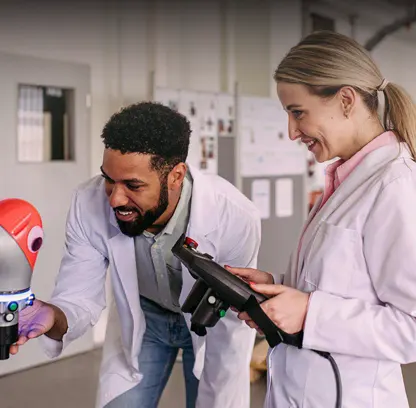
Although some jobs may be rendered obsolete by emerging technologies, many more will be reconfigured to incorporate the unique strengths of human workers and AI-based components. We will see many organizations move from informal use of AI in existing jobs to targeted, workflow-specific use in redesigned human roles.
AI Augmentation

Organizations will develop and replicate use cases that move beyond using basic industrial and software automation for administrative tasks and generative AI for research and meeting summaries. Rather than serving as limited add-ons, intelligent AI agents will fully participate in every workflow, working in concert with humans and with each other.
Blunt Force Automation

Many leaders are considering what processes could be automated versus what would be most beneficial to automate, often highlighting efforts to streamline operations in shareholder communications. While workforce reductions have become more common, some leaders are beginning to rehire employees after realizing that current automation solutions may not be fully capable of operating independently.
Gig Goes Big

The global workforce is moving quickly toward the trend of rapid talent assembly, or constructing short-term teams comprised of different employment resources (e.g., employees, contractors, freelancers, AI agents) for the purpose of solving a specific business problem. Recognizing that fewer full-time employees means fewer overhead expenses and an increased need for agility, these roles will decline in prevalence.
Rapid Relearning
AI Literacy

When mentioned in job descriptions today, AI literacy is an amorphous concept. We will see specific competencies associated with AI literary or fluency emerge, including prompt engineering for existing systems, critical analysis of AI input, and ethical deployment of new AI-based workflows. Far from a panacea for lazy humans, true AI literacy will involve thinking more, not less.
Pre-Industrial Skills

Pre-industrial skills included competencies such as agriculture, survival, manual work and precision craftsmanship. They also include soft skills such as problem-solving, cognitive flexibility, self-reflection, creativity, empathy, intuition, and interpersonal communication. Human workers will need these skills to differentiate themselves from their AI teammates and to keep pace with the demands of the modern world.
Productivity Push
The definition of what it takes to be considered competent at a job is shifting in real-time and is complicated by the fact that many leaders think AI implementation will result in immediate productivity gains. As employee surveillance grows more sophisticated, performance metrics are becoming more objective but also narrower in scope.
Upskilling Renaissance

Upskilling, or teaching employees new skills relevant to their existing jobs, has become mandatory for all frontline and office workers who interface with digital and AI-based systems. Organizations have outgrown the traditional onsite Learning & Development (L&D) model, with a variety of internal and external options from work-based learning via apprenticeships to tuition reimbursement for certifications and degrees at partner schools.
Changing Norms
RTO Mandates

In a dramatic reversal of pandemic-era policy, many multinational organizations are now mandating five-day return-to-office (RTO) policies. Some leaders are requiring employees to work in the same physical office as their teams (known as “return to team”), which represents a further reversal of distributed and remote work.
Declining Trust

Our global society is experiencing a period of change, where established certainties and norms — such as geopolitical stability, a predictable climate, and straightforward career progression — are rapidly evolving. Both leaders and workers are struggling with less clarity around our core systems, data, and business intelligence.
Equity Gaps

According to a 2025 UN report, despite significant gains in poverty reduction, many people teeter on the brink even as they move up the income ladder.1 While wealth and prosperity are increasingly concentrated, economic shocks, persistent inflation, and growing career instability are creating a human experience for most of us marked by fear, anger, and geopolitical polarization.
Power Surge

The rise of AI-driven data centers is dramatically increasing global energy consumption, as these facilities require vast amounts of electricity to support powerful algorithms and nonstop operations. This will increase the need for scalable green energy solutions and a skilled workforce to build and maintain them.
The Succession Crisis
Talent Droughts

In developed nations, fertility rates have dropped below replacement levels due to later marriages, economic instability, and concern about the direction global society is taking. At the same time, the labor force participation rate continues to decrease, potentially reflecting a higher percentage of discouraged workers.
Degree Doubts

While the four-year college degree remains an entrenched global status symbol, its utility is decreasing. Unemployment and underemployment among graduates is rising due to the combination of a challenging business environment and leadership's hopes that AI can replace entry-level roles.
Brain Drains

While the projected brain drain of the 2010s was staved off by economic recession, delayed retirements, and more flexible workforce participation among aging Baby Boomers, we still lack a cohesive infrastructure for protecting and transferring the knowledge of experienced human workers with judgment and expertise that can only be developed through decades of seeing it all.
Leadership Wanes

In the AI age, organizations seek talent with the context and experience to understand when technology is right, when it’s wrong, and how it should be deployed for maximum effectiveness. However, the next generation of senior leaders, Generation X, is quite small, and younger middle manager millennials are struggling with competing life priorities and burnout.
The Driving Forces Shaping the Workforce
For more than 10 years, we have partnered with our clients to explore four underlying forces shaping the future of work. As we look ahead to 2026 and beyond, we examine how the pace of change will accelerate and what it means for employers and the workforce.
Global Expertise to Navigate the Future of Work
ManpowerGroup® (NYSE: MAN), the leading global workforce solutions company, helps organizations transform in a fast-changing world of work by sourcing, assessing, developing, and managing the talent that enables them to win. We develop innovative solutions for hundreds of thousands of organizations every year, providing them with skilled talent while finding meaningful, sustainable employment for millions of people across a wide range of industries and skills. Our expert family of brands - Manpower, Experis, and Talent Solutions - creates substantially more value for candidates and clients across more than 70 countries and territories and has done so for more than 75 years. We are recognized consistently for our diversity - as a best place to work for Women, Inclusion, Equality, and Disability, and in 2024 ManpowerGroup was named one of the World’s Most Ethical Companies for the 15th time - all confirming our position as the brand of choice for in-demand talent.
The ManpowerGroup Work Intelligence Lab is committed to researching global workforce trends to empower both employers and workers to build a brighter future of work. The Work Intelligence Lab provides a global forum for our clients, workforce experts and strategic partners to share insights, discuss challenges and co-create best practices.